 Pay Online
 Contact Us
2025 Water Quality Report - HTML Version (Screen Reader Compatible)
2025 Water Quality Report: Oak Lodge Water Meets or Exceeds all Regulations
2025 Annual Water Quality Report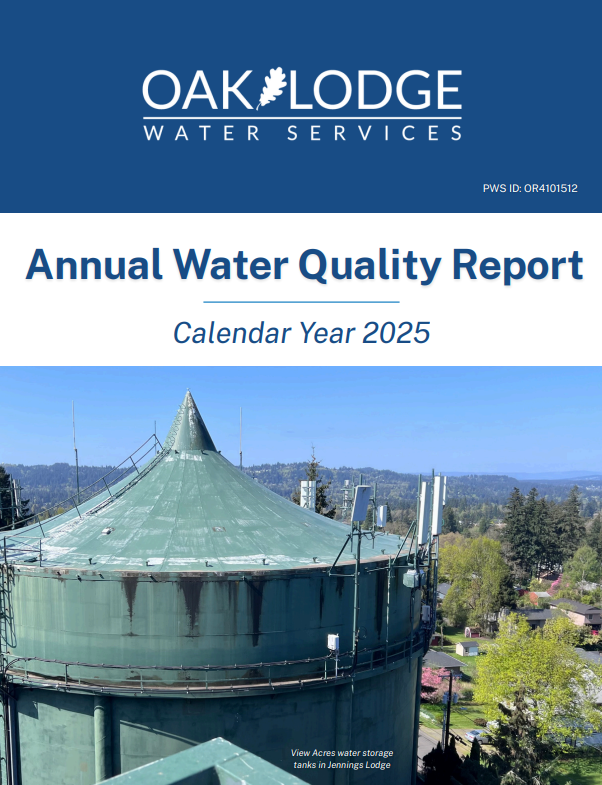
Every day, Oak Lodge Water Services (OLWS) delivers more than 2.5 million gallons of clean drinking water to residents of Oak Grove, Jennings Lodge, and parts of Milwaukie and Gladstone. We’re proud to share this year’s Annual Water Quality Report (also known as a Consumer Confidence Report).
This mandated annual report provides information about your drinking water, including its source, how it’s treated and tested, and how it compares to standards set by state and federal regulatory agencies. Our goal is to promote transparency and help customers better understand their drinking water and feel confident in its safety.
In addition to this report, our team is always available to answer any questions about your drinking water.
You can request a paper copy of the report, at info@olws.org or call (503) 654-7765.
Please contact us if you need a screen reader-compatible or Spanish-language version.
For more information about this report or for any questions about your drinking water, please call Ryan Hunter, Water Field Supervisor, at 503-353-4231 or email us at info@olws.org.
Find Out More About Your Water Source and How to Read This Report:
Source Water AssessmentHow to Read Your Water Quality Report
2025 Report Basics
Water source: Clackamas River
Treatment methods: Slow sand & membrane filtration
Contaminant testing: No violations
Accessibility and Public Participation
Este informe contiene información muy importante sobre la calidad de su agua potable. Tradúzcalo o solicite una copia en español enviando un correo electrónico a info@olws.org.
Help Spread the Word!
Please share this information with anyone who drinks this water (or their guardians), especially those who may not have received this report directly (for example, people in apartments, nursing homes, schools, and businesses). You can do this by posting this report in a public place or distributing copies by hand, mail, email or another method.
Public Meetings
You’re invited to participate in our public meetings. The OLWS Board of Directors holds regular public meetings on the second Tuesday of each month at 4:00 p.m. You can attend online through Zoom or in person at our office: 14496 SE River Road. For more information, visit: oaklodgewaterservices.org/meetings or call (503) 654-7765.
Drinking Water Source: The Clackamas River
Your water travels from the Cascade Range to the Clackamas River.

Oak Lodge withdraws water from the Clackamas River, a high-quality surface water source. The Clackamas River watershed spans nearly 1,000 square miles and is primarily situated in Clackamas County.
The river’s headwaters are located in the Cascade Range near Olallie Butte, with many tributary streams contributing to its flow. Eventually, the river flows through Oregon City, where water is collected and treated at a plant jointly owned by OLWS, Sunrise Water Authority, and the City of Gladstone. These three entities are known collectively as the North Clackamas County Water Commission (NCCWC).
Water is also occasionally received from the South Fork Water Board and Clackamas River Water as a backup supply. After the water is treated, it flows through the approximately 100 miles of water mains that comprise the distribution system carrying water to OLWS customers.
Source Water Assessment

Read the Source Water Assessment here.
In 2019, DEQ completed a Source Water Assessment (SWA) for the North Clackamas Water Commission, of which OLWS is a member. The purpose of this assessment is to identify potential sources of upstream pollution, stemming from human land uses or natural conditions, that could affect our drinking water.
Key pollution risks for our intake on the Clackamas River include:
- Agricultural and forestry activities (e.g., crop production, grazing areas, managed forests, chemical storage/handling)
- Commercial and industrial activities (e.g., gas stations, repair shops, processing and manufacturing facilities)
- Residential and municipal sources (e.g., septic systems, wastewater treatment plants, landfills, parks)
- Infrastructure and transportation corridors (e.g., roads, bridges, stormwater outfalls, utility systems)
If not properly managed, these risks could impact water quality. Our source water protection program addresses these risks through ongoing efforts such as erosion control and watershed management.
Drinking water protection is everyone's responsibility
- Avoid using fertilizers and pesticides. Their chemicals can pollute drinking water sources.
- Pick up after your pets. Bacteria from pet waste can infiltrate groundwater.
- Dispose of chemicals properly. Take used motor oil or other chemicals to a recycling center.
- Keep catch basins clean. Trash and pollutants flow directly to rivers and streams.
How Your Water is Treated
Our water is primarily treated using slow sand and membrane filtration. These two treatment methods operate in parallel, providing redundancy and ensuring we can reliably meet demand.

Slow Sand Filtration
In slow sand filtration, untreated river water is pumped onto half-acre beds filled with layers of sand and gravel. The water first passes through the Schmutzdecke, the top six inches of sand at the surface, which forms a sticky biological mat. In this layer, harmful organisms such as bacteria are trapped or consumed by nonharmful microorganisms. This treatment zone removes particles and helps break down organic matter. As the water continues to flow slowly through deeper layers of sand and gravel, additional contaminants are filtered out, making the water progressively cleaner. Finally, chlorine is added to the filtered water as an extra step to disinfect any harmful organisms that may have passed through the sand filtration process.
Membrane Filtration

Membrane filtration begins when raw river water passes through a straining system that removes large particles. The water then moves into large tanks where chemicals are added to help small substances clump together, forming larger particles that can be more easily filtered out. Next, the water flows through membrane filters. Each filter cell contains 288 membrane modules, and each module consists of about 9,500 individual hollow fibers. A pump draws water through the walls of the membrane fibers, trapping particles on the outside of the fibers. Finally, the filtered water is chlorinated to eliminate any remaining viruses.
Conventional Treatment - Backup Sources
Occasionally, OLWS receives water from the South Fork Water Board or Clackamas River Water as a backup supply. Their water is treated using what’s called conventional filtration. This means that water is pumped to a basin where alum and polymer are added to the raw water as coagulants, allowing particles to stick together. Then the water is moved into a big settling tank, where those clumps sink to the bottom, leaving cleaner water on top. At this point, the relatively clean water is collected and sent to rapid filters. The filtered water is then chlorinated and provided to the NCCWC as needed.
Substances That Could Be in Drinking Water
Drinking water, including bottled water, may reasonably be expected to contain at least small amounts of some contaminants. The presence of contaminants does not necessarily indicate that water poses a health risk. More information about contaminants and potential health effects can be obtained by calling the Environmental Protection Agency's (EPA) Safe Drinking Water Hotline: (800) 426-4791.
Our drinking water comes from the Clackamas River, which is a surface water source. As water travels over land, it dissolves naturally occurring minerals and, in some cases, radioactive material, and can pick up substances resulting from the presence of animals or from human activity:
- Microbial contaminants, such as viruses and bacteria, from sewage treatment plants, septic systems, agricultural livestock operations, and wildlife
- Inorganic contaminants, such as salts and metals, which can be naturally occurring or result from stormwater runoff, industrial, or domestic wastewater discharges, oil and gas production, mining, or farming
- Pesticides and herbicides, which may come from a variety of sources such as agriculture, urban stormwater runoff, and residential uses
- Organic chemical contaminants, including synthetic and volatile organic chemicals, which are by-products of industrial processes and petroleum production, and can also come from gas stations, urban stormwater runoff, and septic systems
- Radioactive contaminants, which can be naturally occurring or be the result of oil and gas production and mining activities
In order to ensure that tap water is safe to drink, the EPA prescribes regulations that limit the amount of certain contaminants in water provided by public water systems. Food and Drug Administration (FDA) regulations establish limits for contaminants in bottled water, which must provide the same protection for public health.
Do I Need to Take Special Precautions?
Some people may be more vulnerable to contaminants in drinking water than the general population. Immunocompromised persons such as persons with cancer undergoing chemotherapy, persons who have undergone organ transplants, people with HIV/AIDS or other immune system disorders, some elderly, and infants can be particularly at risk from infections. These people should seek advice about drinking water from their health care providers. EPA/Centers for Disease Control (CDC) guidelines on appropriate means to lessen the risk of infection by Cryptosporidium and other microbial contaminants are available from the Safe Water Drinking Hotline: (800) 426-4791.
Contaminant Testing Data
We monitor our water for a range of substances on a strict sampling schedule and must meet specific health standards set by regulatory agencies. The table below lists only the substances that were detected last year. Detecting a substance in drinking water does not necessarily mean the water is unsafe to drink. Instead, our goal is to keep all contaminants below their maximum allowed levels.
Disinfectants & Disinfection By-Products
| Contaminant | MCLG or MRDLG | MCL, TT or MRDL | Annual Average(s) | Range of Indiv. Results | Sample Date | Compliant? | Typical Source |
|---|---|---|---|---|---|---|---|
| Chlorine (as Cl₂) (ppm) | 4 | 4 | 0.79 | 0.08 - 1.35 | 2025 | YES | Water additive used to control microbes |
| Haloacetic Acids (HAA5) (ppb) | N/A | 60 | 43.5-45.9 | 15.1-88.3 | 2025 | YES | Byproduct of drinking water chlorination |
| TTHMs [Total Trihalomethanes] (ppb | N/A | 80 | 58.4-66 | 27.4-127.1 | 2025 | YES | By-product of drinking water disinfection |
*Note: Compliance for disinfection by-products (HAA5 and TTHMs) is determined by their long-range running annual average. This means that even if an individual test result spiked above the MCL last year, our average remained within the limit and compliant. In the table above, we show both the annual average data, as well as the lowest and highest values across all testing in 2025 for full transparency.
Microbiological Contaminants
| Contaminant | MCLG or MRDLG | MCL, TT or MRDL | Annual Average(s) | Range of Indiv. Results | Sample Date | Compliant? | Typical Source |
|---|---|---|---|---|---|---|---|
| Turbidity (NTU) | N/A | 1 | N/A | 0.02-0.78 | 2025 | YES | Soil runoff, erosion of natural deposits |
**100% of the samples were below the TT value of 1. A value less than 95% constitutes a TT violation. The highest single measurement was .78. Any measurement in excess of 5 is a violation.
Inorganic Contaminants
| Contaminant | MCLG | AL | 90th Percentile Value | Low Value | High Value | Samples Exceeding AL | Sample Date | Compliant? | Typical Source |
|---|---|---|---|---|---|---|---|---|---|
| Copper - action level at consumer taps (ppm)* | 1.3 | 1.3 | 0.08 | ND | 0.101 | 0 | 2025 | YES | Corrosion of household plumbing systems; erosion of natural deposits |
| Lead - action level at consumer taps (ppb) | 0 | 15 | 2.74 | ND | 16.4 | 1 | 2025 | YES | Lead service lines; corrosion of household plumbing including fittings and fixtures; erosion of natural deposits |
* Compliance for lead and copper is determined by their 90th percentile value. This means that 90% of the sample results were less than the values shown.
Lead Monitoring and Service Line Inventory Results
In the spring of 2024, Oak Lodge Water Services completed the Service Line Inventory, a project mandated by the Environmental Protection Agency (EPA) to review the water service line (the smaller pipe running from the property line to your home) materials in our system.
Under the guidance of the Oregon Health Authority (OHA) and the EPA, we examined historical water system records and performed visual inspections to produce the initial service line inventory. The goal of this project was to document any service lines in our system containing harmful materials like lead, so we could inform customers and coordinate a replacement. During this thorough inspection, our water team confirmed that no lead service lines are present in our system. Our results can be viewed at: www.oaklodgewaterservices.org/service-line-inventory.
Reporting Definitions
MEASUREMENT
ppm: parts per million, or milligrams per liter (mg/L)
ppb: parts per billion, or micrograms per liter (µg/L)
NTU: Nephelometric Turbidity Units. Turbidity is a measure of the cloudiness of the water. We monitor it because it is a good indicator of the effectiveness of our filtration system.
N/A: Not applicable
ND: Not detected
CONTAMINANT REPORTING DEFINITIONS
Maximum Contaminant Level Goal (MCLG): The level of a contaminant in drinking water below which there is no known or expected risk to health. MCLGs allow for a margin of safety.
Maximum Contaminant Level (MCL): The highest level of a contaminant that is allowed in drinking water. MCLs are set as close to the MCLGs as feasible using the best available treatment technology.
Action Level (AL): The concentration of a contaminant which, if exceeded, triggers treatment or other requirements which a water system must follow.
Treatment Technique (TT): A required process intended to reduce the level of a contaminant in drinking water.
Maximum Residual Disinfectant Level (MRDL): The highest level of a disinfectant allowed in drinking water. There is convincing evidence that addition of a disinfectant is necessary for control of microbial contaminants.
Maximum Residual Disinfectant Level Goal (MRDLG): The level of a drinking water disinfectant below which there is no known or expected risk to health. MRDLGs do not reflect the benefits of the use of disinfectants to control microbial contamination.
Herbicide: Any chemical(s) used to control undesirable vegetation.
Pesticide: Any substance, or mix of substances, intended to prevent, destroy, repel, or mitigate any pest.
Contaminant: Any physical, chemical, biological, or radiological substance or matter in water.
EPA Guidance About Lead Safety

A text-only version of the Sources of Lead in Drinking Water graphic is available here.
There is no safe level of lead in drinking water. Exposure to lead in drinking water can cause serious health effects in all age groups. Infants and children can have decreases in IQ and attention span. Lead exposure can lead to new learning and behavior problems or exacerbate existing learning and behavior problems. The children of women who are exposed to lead before or during pregnancy can have an increased risk of these adverse health effects.
Adults can have increased risks of heart disease, high blood pressure, kidney, or nervous system problems.
How We Control for Corrosion in Our System
Corrosion of pipes, plumbing fittings, and fixtures may cause lead and copper to enter drinking water. To assess corrosion of lead and copper, OLWS conducts tap sampling for lead and copper at selected sites annually. During treatment, soda ash is used to control corrosion, which was designated as the optimal corrosion control treatment by the Authority. To ensure the treatment is operating effectively, NCCWC treatment plant staff monitor pH daily and alkalinity weekly.
Be Aware of Risks to Protect Yourself and Loved Ones
Lead can cause serious health problems, especially for pregnant women and young children. Lead in drinking water is primarily from materials and components associated with service lines and home plumbing. OLWS is responsible for providing high-quality drinking water and removing lead pipes, but cannot control the variety of materials used in plumbing components in your home. Because lead levels may vary over time, lead exposure is possible even when your tap sampling results do not detect lead at one point in time.
You can help protect yourself and your family by identifying and removing lead materials within your home plumbing and taking steps to reduce your family's risk. Using a filter, certified by an American National Standards Institute accredited certifier to reduce lead, is effective in reducing lead exposures. Follow the instructions provided with the filter to ensure the filter is used properly. Use only cold water for drinking, cooking, and making baby formula. Boiling water does not remove lead from water.
Before using tap water for drinking, cooking, or making baby formula, flush your pipes for several minutes. You can do this by running your tap, taking a shower, doing laundry or a load of dishes. If you have a lead service line or galvanized requiring replacement service line, you may need to flush your pipes for a longer period. If you are concerned about lead in your water and wish to have your water tested, contact OLWS at (503) 654- 7765. Information on lead in drinking water, testing methods, and steps you can take to minimize exposure is available at epa.gov/safewater/lead.
PFAS and Your Drinking Water: What to Know

You may have heard about PFAS—also known as "forever chemicals"—in the news and wondered if they’re in your drinking water. The good news: none have been detected in our system.
PFAS (per- and polyfluoroalkyl substances) are man-made chemicals used in products like non-stick pans, water-repellent clothing, and stain-resistant fabrics. Over time, they can make their way into the environment, including water sources.
While research is ongoing, high levels of PFAS may pose health risks. That’s why the Environmental Protection Agency (EPA) is closely monitoring them.
As part of a federal testing program, our water was tested from July 2023 to April 2024 for 29 types of PFAS and lithium. None were detected.
We’re committed to protecting your water quality and will continue to monitor developments and share important updates with you.
Be Two Weeks Ready: Store Water for Emergencies
Oregon Emergency Management (OEM) recommends having an emergency plan and enough supplies for you and everyone in your household to survive for at least two weeks following a disaster. In extreme circumstances, like a major earthquake, water and wastewater infrastructure may be damaged, leading to service disruptions. That’s why it’s important to have emergency water stores at home to sustain you and your family until systems can be restored. Store 1 gallon per person per day to have enough water for drinking and sanitation during an emergency (don’t forget to factor in pets, too!).
Find more emergency preparedness resources at: www.oregon.gov/oem.
Investing in Our Drinking Water Future
We’re protecting the longevity and safety of our water system through several major improvement projects. Learn about some of the work currently underway:
Oatfield Rd. Main Replacements

Project At-A-Glance
Purpose: Replace vital system “backbone”
Cost: $8,568,500
Timeline: FY 2026 - 2030
Oatfield Road makes up part of the “backbone supply” in our water system. This means it serves a large number of residents and highpriority locations (e.g., schools and care facilities). This, along with its age and fire flow deficiencies, made it a top priority for main replacements.
Construction began in the fall of 2025 and, when complete, the project will replace more than 16,000 feet of mainline pipe. This includes upsizing from 6 to 8 inches to increase capacity and swapping out cast iron with more durable, corrosion-resistant ductile iron.
Result: Fewer main breaks and improved service reliability for years to come.
Water Reservoir Recoating

Project At-A-Glance
Purpose: Protect water storage assets
Cost: $482,000
Timeline: FY 2027
Our water storage tanks are the first stop for treated water when it leaves the treatment plant and before it’s distributed to homes and businesses throughout our community.
The tanks are treated with an exterior coating that repels water and shields the structures from the elements. Over time, this protective layer wears down, impacting the integrity of the structure.
Tanks also receive an interior coating to prevent corrosion, rust, and structural deterioration, which extends their lifespan. In 2026, we’ll re-coat all four of our storage tanks to keep them in top condition.
Result: Reliable assets so that we can always deliver clean, safe drinking water to our customers.
Find the latest on our projects at: www.oaklodgewaterservices.org/active-projects